The Future of Search for Self Storage: Google, AI, ChatGPT, and What Actually Matters in 2026

Search is changing so much that it’s time to do an update on a previous post we did back in November of 2025! We discovered some new data when preparing for a few recent round table discussions on this very same topic.
ChatGPT and other AI tools are now a major part of how people ask questions, research options, compare ideas, and get advice. Google is pushing AI deeper into search results. Gemini is gaining ground. Tools like Perplexity looking to disrupt the whole model. More answers are being delivered before a user ever clicks a website. And the customer journey is becoming less linear than it used to be.
That matters for self-storage. But it also needs to be put in perspective with some good numbers!
Because when someone needs a storage unit this weekend, needs to compare prices, wants directions, checks reviews, or searches “storage near me,” Google is still the front door.
Google Is Still the Big Gorilla in Search

Let’s start with the obvious: Google is still massive (just like Edward).
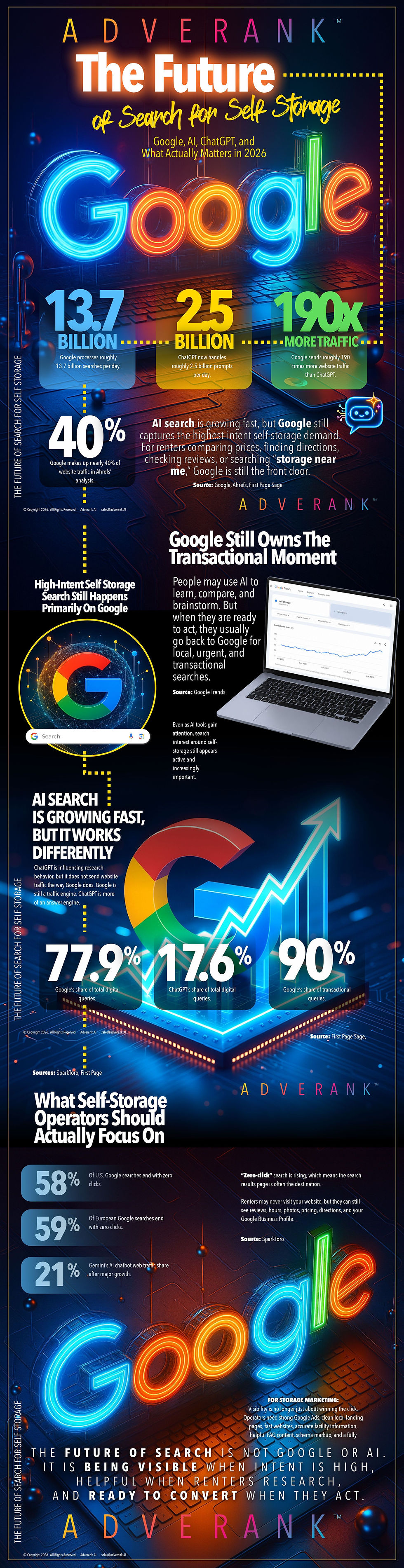
Google processes roughly 13.7 billion searches per day, based on Google’s own stated figure of more than 5 trillion searches per year. ChatGPT, meanwhile, handles roughly 2.5 billion prompts per day, or about 912 billion annually. That is enormous growth for ChatGPT, but Google is still operating at a much larger daily scale.
In other words, ChatGPT is not some tiny side tool anymore. It is a real behavior shift. But Google is not going away and is actually still growing in usage.
Ahrefs’ comparison found that ChatGPT’s total prompt volume equals about 18% of Google’s daily search volume. When narrowed to prompts that look more like traditional searches, Ahrefs estimates ChatGPT is closer to 12% of Google’s search volume.
That is big. That’s more than any other tool has done before, and in such a short period of time!
It is also not necessarily a replacement.
For self-storage operators, this distinction matters. If someone asks ChatGPT, “What should I look for when renting a storage unit?” that may influence their decision. But when they search “climate-controlled storage near me,” “10x10 storage unit in Zionsville,” or “RV storage near me,” they are still very likely going to Google.
ChatGPT Is Growing, But It Does Not Send Any Website Traffic

This is where the story gets really important.
ChatGPT may be getting a massive amount of usage, but that does not mean it sends traffic to websites the way Google does.
Ahrefs analyzed web traffic across 76,000 websites and found that Google makes up nearly 40% of website traffic, while ChatGPT accounts for just 0.21%. Put another way, Google sends roughly 190 times more traffic to websites than ChatGPT.
That tells us something important. Google is still a traffic engine. ChatGPT is more of an answer engine and thought partner.
Google sends people somewhere. ChatGPT often keeps people in the conversation.
That does not make ChatGPT unimportant. It means operators need to understand where it fits. ChatGPT may influence the research stage, but Google is still doing the heavy lifting when it comes to clicks, maps, calls, directions, website visits, and reservations.
For self-storage, that is the part that pays the bills.
Not Every Query Is the Same
The biggest mistake marketers make when talking about AI search is treating all “searches” like they are equal.
They are not.
There is a huge difference between:
“What size storage unit do I need for a two-bedroom apartment?”
and
“Storage units near me open today.”
The first question is informational. ChatGPT can handle that well. The second is local, urgent, transactional, and tied to maps, inventory, location, pricing, reviews, and availability. That is Google’s world.
A 2026 market-share report from First Page Sage estimated that Google still controls about 77.9% of total digital queries, compared to 17.6% for ChatGPT. But the more useful breakdown is by intent: Google leads with 93% share for navigational queries and 90% share for transactional queries, while ChatGPT leads in generative and creative queries.
That lines up with what we see in self-storage.
People may use AI to learn. They may use it to brainstorm. They may even use it to compare what matters when choosing a storage facility. But when they are ready to act, they usually go back to Google.
Gemini Is the Wild Card
ChatGPT may get most of the attention, but Google is not sitting still.
Gemini is becoming a bigger player in AI usage, and that matters because Google controls the most important distribution channel in search. First Page Sage reported that ChatGPT still leads AI chatbot web traffic, but Gemini’s share grew from roughly 5.7% to 21.5% year over year, driven in part by integration across Google Search, Android, and Workspace.
Google does not need users to “switch” to a new behavior overnight. It can bring AI into the behavior people already have. That is exactly what Google is doing with AI Overviews, AI Mode, and Gemini-powered experiences inside the search ecosystem.
For self-storage marketers, the takeaway is not “optimize for ChatGPT instead of Google.”
The takeaway is: Google search is becoming more AI-assisted, but it is still Google search.
The Rise of Zero-Click Search
The other major trend is zero-click search.
A zero-click search happens when someone gets what they need from the search results page without clicking through to a website. That could be a map result, a featured snippet, a business profile, an AI Overview, a phone number, hours, pricing, or another answer-style result.
That means the search results page itself is becoming the destination.
For self-storage operators, this is not necessarily bad. A renter may never click your website but still see your facility, compare your reviews, tap to call, request directions, or check your hours.
But it does change how operators should think about visibility. It puts more empahsis on your Google Business Profile, reviews, photos, pricing visibility, local landing pages, schema markup, and ad presence. You are not just trying to win the click. You are trying to win the moment.
What This Means for Self-Storage Operators

Here is the practical version.
Do not panic about AI search.
Do not ignore it either.
The self-storage customer journey is changing, but the fundamentals are still very much alive.
Google Ads are still the highest-intent marketing channel for self-storage
\When someone searches for storage near them, they are not casually browsing. They are showing intent.
That is why Google Ads continue to matter so much in self-storage. Operators should still be focused on high-intent local keywords, clean location targeting, strong ad copy, relevant landing pages, and budgets that reflect occupancy goals.
The mistake would be pulling money away from Google just because AI search is getting attention.
AI may influence research. Google still captures demand.
Your website still needs to convert
Even if AI search reduces some clicks over time, the clicks you do get become even more valuable.
That means your website needs to do its job quickly.
Can renters find unit sizes? Can they see pricing? Can they rent online? Is the mobile experience fast? Is the checkout process simple? Are location pages clear? Are reviews, directions, features, and FAQs easy to find?
If someone comes to your site after doing research in Google, ChatGPT, Gemini, or anywhere else, do not make them work.
Content should answer real renter questions
AI tools love clear, useful, structured answers.
That means self-storage operators should have content that answers questions like:
What size storage unit do I need?
How much does self-storage cost in this city?
What is climate-controlled storage?
Can I store a vehicle, boat, or RV?
What should I not put in a storage unit?
How do I rent a unit online?
This is not about writing fluffy SEO content. It is about creating useful answers that can help renters and make your facility easier for search engines and AI tools to understand.
Structured data and clean facility information matter more
As search becomes more answer-driven, machines need to understand your facility information clearly.
That means your site should have accurate location data, unit information, reviews, pricing where appropriate, hours, amenities, FAQs, and schema markup.
This helps Google understand your pages. It may also help future AI systems interpret and summarize your business more accurately.
In plain English: make your website easy for both people and machines to understand.
Google Business Profile is part of your conversion funnel
In a zero-click world, your Google Business Profile is not just a listing. It is often the first impression and the last impression when doing brand searches.
Photos, reviews, hours, categories, services, Q&A, and location accuracy all matter.
For local businesses like self-storage, your map presence can be just as important as your website visit.
AI visibility is worth watching, but not worth obsessing over yet
Should operators care whether they show up in ChatGPT, Gemini, Perplexity, and AI Overviews?
Yes.
Should they completely rebuild their marketing strategy around it?
No.
Right now, Google still sends far more traffic to websites than ChatGPT, and Google still dominates transactional and navigational behavior.
The smart move is to prepare without overreacting.
Create useful content. Strengthen your local presence. Improve your website. Add structured data. Build a brand that is clear, consistent, and easy to understand.
That helps with Google today and AI visibility tomorrow.